
QUIET HOURS | AXIS BANK | 2025
A security feature allowing users to schedule when their money can't move

TEAM
Product Designer
Product Manager
3 Engineers
MY ROLE
Conceptualization
Design
UX Copy
Prototyping
Dev handoff
DURATION
3-4 weeks


Context

Digital fraud in India grew 9× in three years
From 2.6 lakh cases in 2021 to over 24 lakh in 2024. Most of it happened through the same channels people use every day - UPI, NEFT, IMPS - to pay rent, send money home, settle bills.
24L+
Reported fraud cases in 2024, up from 2.6L in 2021
₹22.8Cr
Lost to digital fraud in 2024
23M+
Users on Axis Bank Mobile Banking
Axis Bank had already responded with Safety Centre — a dedicated space inside Mobile Banking where users could take control of their own account security. Turn off internet banking access. Freeze UPI. Block outgoing fund transfers entirely.
It was covered in The Hindu Business Line and Banking Frontiers. Users were finding it and using it.

What users were already doing

Safety Centre analytics revealed a specific pattern. Users were manually toggling fund transfer access off, and then back on again creating their own protection windows, one toggle at a time, every single time they needed it.

70%+
Fund transfer settings visits came from returning users
Left on OFF
A meaningful share of users who disabled fund transfers never re-enabled them - restricting their own access without realising
2× per visit
Average number of times returning users interacted with the fund transfer toggle
Quiet Hours lets you schedule when your fund transfers are off limits.
Pick the window. It repeats as per your preference.
You stay protected during the hours you're least likely to catch something suspicious.

Approach

Reframing the question
The design challenge wasn't "how do we let users block fund transfers." It was "how do we build something that works reliably on a schedule, without users having to think about it every day."
That shift mattered for every decision that followed.
Looking outside banking
Traditional banks and neobanks had no strong equivalent. Time-based transfer blocking simply didn't exist as an established pattern, which meant there was no direct reference to borrow from.
The mental model that made most sense came from scheduling systems and calendar-based controls. That's where users already have intuition for recurring time windows - set it once, it runs, it knows when to stop.
One constraint that came from that same thinking
Scheduling systems don't block everything blindly. They have logic for what's important enough to get through anyway.
Quiet Hours needed the same. EMIs, bill payments, SIPs - pre-authorised transactions that users set up precisely because they didn't want to manage them manually. Blocking those would cause financial penalties and break the trust the feature was trying to build.
Quiet Hours applies only to new, user-initiated transfers. Everything pre-authorised goes through uninterrupted.
Decisions

Where does this feature live?
Quiet Hours is technically a fraud prevention feature — which puts it logically in Safety Suite. But contextually, it belongs in Fund Transfer under Control Centre. That's where users come when they want to manage how their money moves. Reaching them there meant catching them at the right moment.

How does this appear?
The business proposal was reactive: show a bottom sheet when a user taps to turn off fund transfers, offering Quiet Hours as an alternative. The problem with reactive is that it intercepts an action the user has already decided to take. It would feel like an obstacle, not an offer.

The decision was to make it proactive: always visible on the Fund Transfer page, never intercepting anything. Then the question became what form that entry point should take.
IDEA 1: Toggle
A toggle on the Fund Transfer page. Tapping it switches Quiet Hours on. Familiar, low-effort, consistent with everything else on the page.

IDEA 2: Chevron
A tappable row with a right arrow. Tapping it takes users to a dedicated Quiet Hours configuration screen.

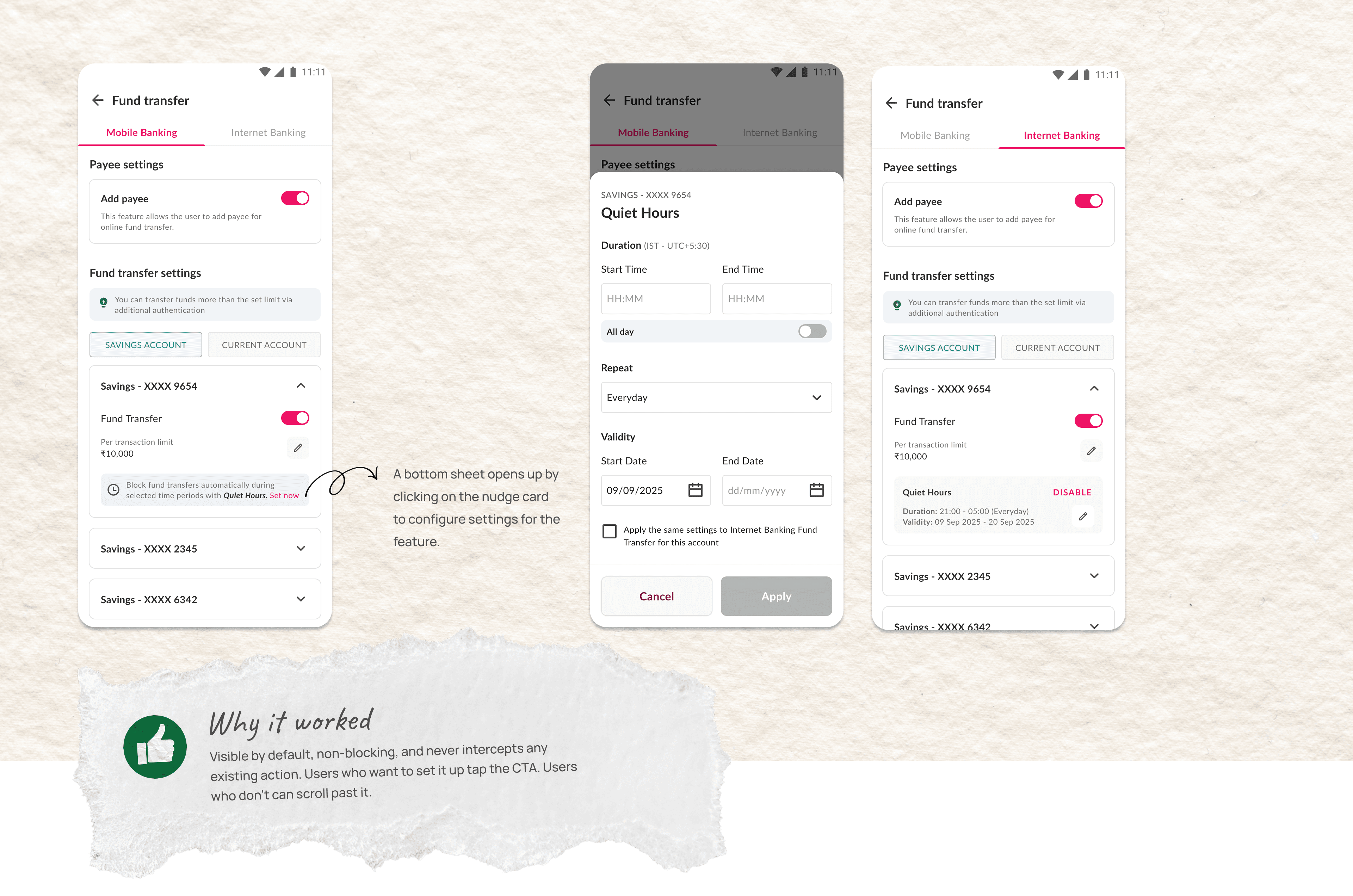
IDEA 3: Nudge Card ✅
A card below the existing fund transfer toggle with one line of context and a "Set now" CTA. Tapping it opens a configuration bottom sheet. Once set up, the card transforms into a status view showing the active schedule, with edit and disable options inline.
Other additions
What about users with multiple accounts?
Users with multiple accounts would otherwise have to configure Quiet Hours separately for each account.
To reduce repeated setup, I proposed an additional step where users can apply the same settings to their other eligible accounts in one go. This step is completely skippable — users can either continue with just one account or extend the same configuration across multiple accounts.
Users with a single account never see this step.

What shipped

Outcome

No dedicated in-app campaign. No push notification. No promotional placement.
That number makes more sense when you look back at what the data had already shown: users weren't being introduced to a new behaviour. They were being given a better way to do one they'd been managing manually for months.
Feature launched April 2026. Longitudinal data on repeat activation being tracked.
Key takeawys
What This Project Taught Me
The emotional outcome gap
The feature was validated with behavioral data, not conversations with users. The analytics told you people were manually toggling transfers. Adoption tells you they set Quiet Hours up. But the actual job of this feature was to make people feel safer, and there's no data on whether it did that. Did users feel less anxious about their accounts after setting it up? Did they stop checking their phone at 2am? That's the real success metric, and it was never defined or measured. I'd go back and figure out how to track that now, even post-launch.
The multi-account scoping problem
The multi-account flow came after the base flow was done. It surfaced from asking "what happens next" rather than from mapping the full system at the start. That's a sequencing problem. Users with multiple accounts aren't an edge case at a bank, they're a significant chunk of the user base. A more deliberate systems mapping exercise at the beginning would have caught this before it became a late addition.
The EMI communication gap
The feature tells users their transfers are paused during Quiet Hours, but it's less clear about what still goes through. EMIs, SIPs, bill payments continue uninterrupted. That's the right call, but users setting this up for the first time might not fully understand it. If I were going back, I'd look at whether the confirmation screen communicates that clearly enough, because a user who sets Quiet Hours and then finds an EMI went through during it might feel like the feature failed them, even though it worked exactly as designed.
Still here? Let's make something ↓

What I'm looking for
(go on - tick all three)
hard problems with no rule-book
a team that sweats the craft
room to own the whole problem
P.S find me here ↓
samasaishreya@gmail.com
linkedin.com/in/shreya-sama/
Resume


Crafted with love & care ♥️
© 2026 Shreya Sama. All rights reserved.